
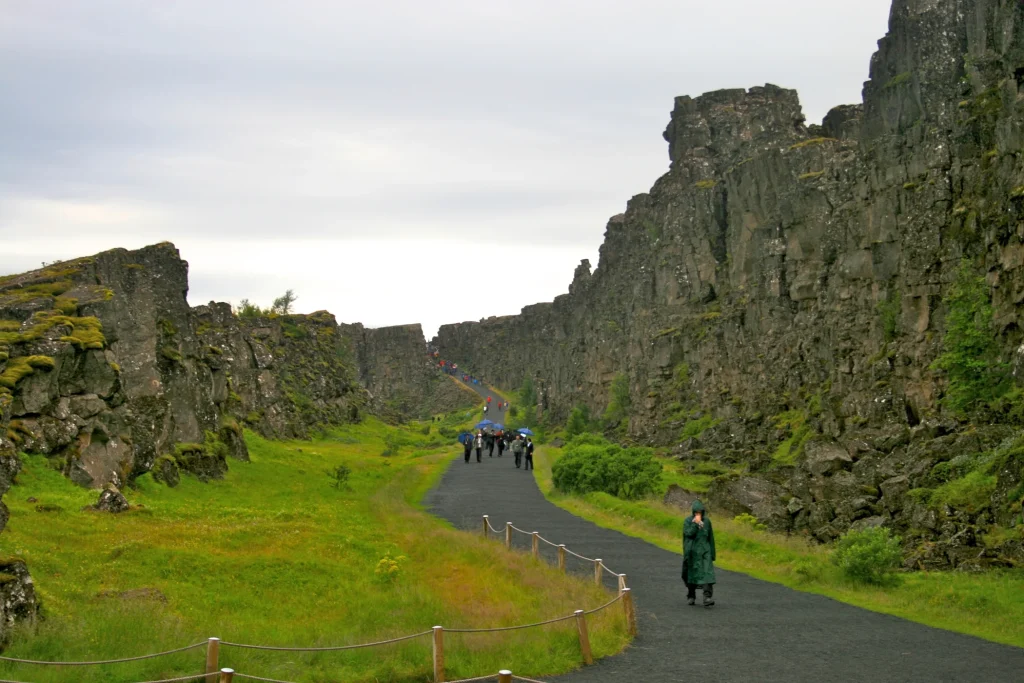

Þingvellir brings two kinds of story into the same view. There is the visible form of the land: cliffs, fissures, open ground and the wider setting of Þingvallavatn. There is also the history of an assembly place, where people gathered to make laws and settle disputes. A rewarding visit leaves space for both.
Begin with the wider setting
Look at how the rocky walls frame the lower ground before concentrating on a single photograph. Almannagjá offers one way to recognize that relationship. The view is part of a larger rift landscape, rather than a single crack that explains everything you can see. Reading a park map alongside the scenery gives the different names somewhere to belong.
Use the park’s current visitor information to decide which paths and viewpoints suit your visit. A photograph of a path on a summer day does not establish its condition when you arrive. The rainy Almannagjá image in this guide was made in 2011; its date is included so the scene can be understood as a recorded moment.
Give the assembly story time
UNESCO describes Þingvellir as the place where the Alþing was established in 930 and continued to meet until 1798. Its cultural importance includes the assembly remains and the surrounding landscape associated with those gatherings. Read the UNESCO account of Þingvellir for that historical framework.
On the ground, interpretation helps distinguish an archaeological trace from a much later building or feature. Avoid expecting every part of the history to announce itself through a large structure. A place where people assembled can carry its significance through ground, routes, names and remains as well as architecture.
Choose a visit you can actually enjoy
Decide what you want to pay attention to before fixing the rest of the day. Someone interested in the assembly landscape may want a different emphasis from a visitor concentrating on geological views. Neither preference requires turning the stop into a hurried search for every named feature.
- Read the park’s visitor information and check current notices.
- Choose the particular paths, viewpoints or interpretation you want to include.
- Allow time to move between them at your own pace.
- Keep the rest of the journey flexible enough to accommodate conditions.
Carry the context into the next stop
Þingvellir is one part of the Golden Circle, alongside the Geysir geothermal area and Gullfoss. Those places have different visitor settings and deserve separate planning. A tour description that names all three still needs to explain its route and the time it proposes at each place.
For practical updates, use Þingvellir National Park’s own website. For the overall journey, begin with our planning guide. The aim is a visit with enough room to notice the landscape and understand why this ground matters.

Golden Circle Classic Day Tour from Reykjavik
Discover some of the best sites in Iceland on the the Golden Circle Tour, in the company of a professional guide who will tell you all you need to kno...

Small-Group Golden Circle, Blue Lagoon with Ticket & Kerid Crater
The Golden Circle and the Blue Lagoon are the two most popular sights to visit in Iceland. Book this small group day...
Golden Circle, Volcano Crater and Blue Lagoon Small-Group Tour
Experience the best of Iceland's natural wonders on this one day mini bus tour. Join us for this magnificent combina...

Silfra: Snorkeling Between Tectonic Plates - Meet on Location
Enjoy a once-in-a-lifetime experience with a snorkeling tour of Silfra fissure! Float between two tectonic plates...